HTML Block and Inline Elements
Every HTML element has a default display value, depending on what type of element it is.
There are two display values: block and inline.
Block-level Elements
A block-level element always starts on a new line.
A block-level element always takes up the full width available (stretches out to the left and right as far as it can).
A block level element has a top and a bottom margin, whereas an inline element does not.
The <div> element is a block-level element.
Example:
<div>Hello World!</div>
Block level elements in HTML are:
<address><article><aside><blockquote><canvas><dd><div><dl><dt><fieldset><figcaption><figure><footer><form><h1><h2><h3><h4><h5><h6><header><hr><li><main><nav><noscript><ol><p><pre><section><table><tfoot><ul><video>
Inline Elements
An inline element does not start on a new line.
An inline element only takes up as much width as necessary.
This is a <span> element inside a paragraph.
<span>Hello World</span>
Inline elements in HTML are:
<a><abbr><acronym><b><bdo><big><br><button><cite><code><dfn><em><i><img><input><kbd><label><map><object><output><q><samp><script><select><small><span><strong><sub><sup><textarea><time><tt><var>
An inline element cannot contain a block-level element!
Most used elements
The <div> Element
The <div> element is often used as a container for other HTML elements.
The <div> element has no required attributes, but style, class and id are common.
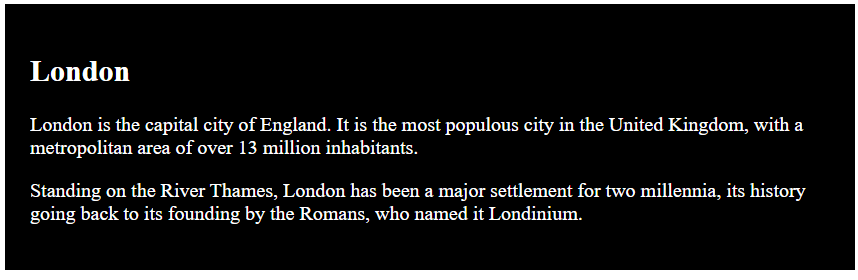
When used together with CSS, the <div> element can be used to style blocks of content:
Example:
<!DOCTYPE html>
<html>
	<body>
		<div style="background-color:black;color:white;padding:20px;">
			  <h2>London</h2>
			  <p>London is the capital city of England. It is the most populous city in the United Kingdom, with a metropolitan area of over 13 million inhabitants.</p>
			  <p>Standing on the River Thames, London has been a major settlement for two millennia, its history going back to its founding by the Romans, who named it Londinium.</p>
		</div>
	</body>
</html>
Output:
The <span> Element
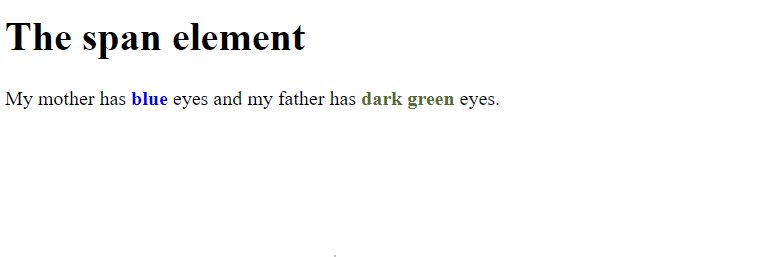
The <span> element is an inline container used to mark up a part of a text, or a part of a document.
The <span> element has no required attributes, but style, class and id are common.
When used together with CSS, the <span> element can be used to style parts of the text:
<!DOCTYPE html>
<html>
	<body>
		<h1>The span element</h1>
		<p>My mother has <span style="color:blue;font-weight:bold">blue</span> eyes and my father has <span style="color:darkolivegreen;font-weight:bold">dark green</span> eyes.</p>
	</body>
</html>
Output: